 |
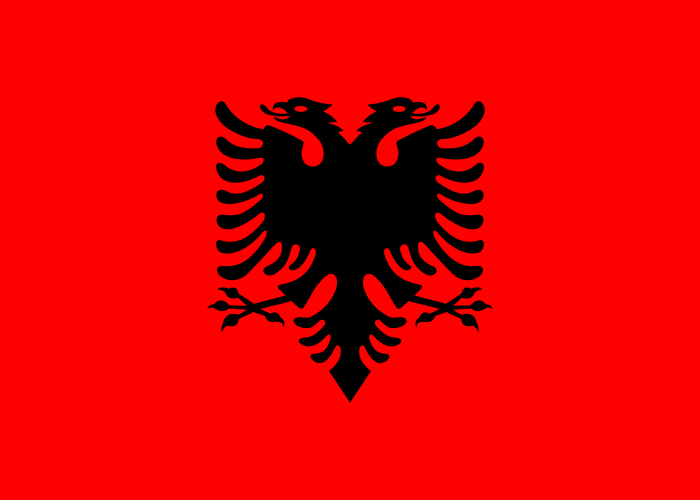
| Albanian Flag |
Hello and welcome to my second blog post about the world around me. The first one was about Kazakhstan; today's is about Albania.
...wait, where's that?
 |
| Map of Albania (in German), east of Italy |
What did I know about Albania beforehand? Not much, except:
- Enver Hoxha and his 50 or so years of Communist rule
- Bunkers here, bunkers there, bunkers everywhere
- Part of the Balkans, east of Italy
- Blood feuds and northern Albania
And also, my second year French teacher was from Albania (
Shkodër, to be exact). So now, a little digression:
An French teacher originally from Albania, living in the USA
How cosmopolitan. In fact, the year she taught my class was the first year she taught in the United States. It's too bad, since my class made a very atrocious first impression on her. Anyways, she let even the most recalcitrant reprobates pass the class. She also taught Spanish and knew five languages.
What I learned about Albania
First of all, the Balkans have a tumultuous history. Apparently, no buses run from Albania to other countries. Therefore, to enter the country, you can either fly by plane, or you can take a car to the border, cross the border line on foot, and hitchhike to the other side. Speaking of flying by plane, Belle Air, one of Albania's principal airlines, suspended operations recently due to financial problems.
Another thing about borders is that Croatia and Albania don't really seem to have such an amicable relationship. For one thing, Croatia recently joined the EU and wants to move forward from it's shoddy corrupt past. Well, Albanians crossing the border into Croatia by car know very well that Croatian border guards kind of want bribes. Well, they don't really accept them anymore due to the EU accession thing. One American traveler recounts how her Albanian friend/driver was harassed by Croatian border guards and had his car meticulously searched at the border. They didn't find anything. It's just an interesting anecdote; it has (hopefully) gotten better now.
 |
| Public transportation |
One could apply the derogatory label "backwards" to the country of Albania. However, just because it isn't as advanced as the Western world doesn't mean it's necessarily worse. One thing is the produce. Apparently, there are very few, if any, supermarkets in Shkoder, a major city in the western Balkans. So, the local people get their produce fresh at the market, sold by farmers. This is actually fresh produce sans the chemicals and other additives that can maybe be found in the fruit I'm eating right now.
Where do you throw away the plastic bags that you get at the market? The trash. However, Albania doesn't really have a well-functioning garbage disposal system. In fact, there is a shortage of landfills. Recycling is probably nonexistent. Or is it? Well, in Shkoder, the municipal government pays people to turn in metal, glass, and plastic. Most people are too indolent or simply aren't cognizant of this opportunity.
A totally related digression: the Roma people, also referred to as "Gypsies". These people are marginalized by society and face institutionalized discrimination. In the Shkoder area, the Roma people live in a small village that stands apart from Shkoder. Some Roma go into Shkoder to beg. And now this is the end of this small digression. Anyways…
In the morning, the Roma go through the neighborhoods and shout for old metal. This is how the residents of Shkoder can dispose of their old appliances. At the same time, the Roma are getting paid for their time and effort when they bring the old appliances to the municipal government. The old appliances are then presumably recycled. In this way, the Roma fill a very important void.
Roads
 |
| On the move |
Speaking of driving, apparently 90% to 95% of all vehicles in Albania are stolen from owners in other European countries. Let's say that you stole a car in central Italy and then drove it back to Albania. It would take only about 14 hours. Speaking of driving, it seems that Albania has an atrocious road safety record. Also, the road conditions are poor in the north.
 |
| Theth Valley, northern Albania |
Some very interesting history
 |
| Kullë in Theth |
What else is in the north besides poor road conditions? It has an enthralling history. Hopefully my simplified version is at least somewhat accurate. Anyways, in the 15th century, Lekë Dukagjini (Albanian prince) codified a set of laws, called the Kanun (actually, there are six variations of it). The Kanun was passed down orally and was only first written down in the 19th century. The Kanun is very specific and has 1,262 articles, which regulate pretty much every aspect of life. In the Kanun, there is a reoccurring theme of upholding honor (called Besa). A person's honor is based on his conduct. Probably the most controversial and (in)famous part of the Kanun is the part that deals with murder:
If one committed a murder or was humiliated, his honor would be ruined...but could be salvaged by murder. And then the family of the murdered person would be obligated to kill the murderer, and the cycle repeats until...all men in the two families are killed. This practice has also spawned the construction of fortified towers, known as kullë. A man who has "incurred the blood" (read: the other family is trying to kill him) can seek refuge in these towers during the day and flee to another tower in the night. You can read parts of the Kanun here: http://www.shkoder.net/en/kanun_en.htm
Albania, hospitality, Jews, and World War II
After that all the death in the previous paragraphs, you may be inclined to think that Albania is a bloody and savage country of barbarians. That is very far from the truth. What else stems from the Kanun? There is this concept of Besa, which has multiple meanings, one of which means "taking care of those in need". Albania is not as rich as it's neighbors to the west, however it can offer a kind of protection...
The atrocities committed against the Jews, Roma, disabled, and homosexual people during World War II can never be forgotten. There are many harrowing stories of ordinary people taking heroic steps to protect Jews from the claws of the Nazis. In Albania too, many people accepted Jews into the country. However, they were not always hidden; they were accepted into Albanian society, even as it was under Italian occupation. Later the Germans invaded, and many Albanians helped the Jews escape from Albania's sea ports. Before the war, there were 200 Jews living in Albania, which was predominantly Muslim. At the end of the war, there were 2000. After the Communist government fell, they mostly emigrated abroad to the US or Israel.
Uyghurs in Albania
Have you heard of the Uyghurs? They are a Turkic ethnic group that lives primarily in western China. Some also want independence from China, which caused the Chinese government to start making problems for the Uyghurs. Anyways, what does this have to do with Albania? Well, one similarity between Albania and China is that both were once contemporaneously conspicuous Communist countries (that was alliteration) and they sort of had a relationship due to their similar political structures. Anyways, five of these Uyghurs have experienced an extraordinary journey. They traveled from China to Pakistan, possibly strayed into Afghanistan, were captured by Pakistanis and turned over to the Americans, who then extraordinarily rendered them to Guantanamo Bay, and then eventually they somehow ended up in Albania. What...how did that happen?
So anyways, a group of Uyghurs decided to travel abroad to seek a country where their families could live in peace. They traveled to Pakistan and then possibly crossed into Afghanistan. At the same time, the United States was embroiled in its "War on Terror" and was offering money for captured terrorists. Well, a couple of opportunist Pakistanis captured the Uyghurs by luring them into a mosque, and then they handed the Uyghurs over the the American soldiers in return for some money. The Uyghurs had no idea what was going on since they weren't actually terrorists. Basically, they were somewhat reassured to be in the hands of the Americans since they viewed the United States as a country of freedom. More importantly, however, they did not want to be sent back to China, fearing retribution. They were held in a prison for six months and were regularly told that they would be freed soon. After six months, they were flown to Guantanamo Bay. There, they were told that they were going to Albania.When the plane landed, it was night and completely dark outside. Was this really Albania? The Uyghurs thought that they were actually deported to China. Then, they saw some Europeans and felt reassured. Today, they are living in Albania, although they are separated from their families. They say that they've been accepted by their Muslim brothers (Albania is a predominantly Muslim country) but still lack marketable skills. One is working at a pizza shop. You can read more here: http://www.pbs.org/frontlineworld/stories/albania801/interview/bakker.html
History Tidbits
 |
| Enver Hoxha |
There once was a man from Gjirokastër, which, by the way, has a well-preserved old town from the Ottoman period. This man was called Enver Hoxha (pronounced like "Ho-cha"). He was the leader of Albania, when it was still a Communist country (officially branded as a Socialist country). Anyways, Hoxha's rule was characterized by good and bad aspects. First, he seized land from rich landowners and redistributed it to the poor. Under his rule, the University of Tirana was founded. Malaria was eradicated due to advances in the healthcare system. He also outlawed blood feuds (mentioned earlier). Anyways, Albania and Yugoslavia's relationship started to deteriorate, and then Hoxha aligned himself with Russia. That didn't last too long as Russia was implementing reforms at the time, reforms that Hoxha didn't want implemented in Albania. Later, he forged an alliance with China. In the later part of his rule, other interesting developments took place. He compared women to sacks and abrogated their rights. However, during the Cultural and Ideological Revolution, he changed reversed the laws that discriminated against women. Women were encouraged to take government jobs. Female graduation from high school still skyrocketed under his leadership. In fact, adult illiteracy was obliterated. Then, direct taxation was abolished. On October 25, 1970, Albania became the first fully electrified nation in the world. The quality of schooling and health care was still improving.
Hoxha was also an erratic leader. He built 750,000 one-man concrete bunkers across the whole country. Hypothetically, every citizen could run to a bunker in wartime and defend Albania against invaders. Some bunkers were also stocked with chemical weapons...
 |
| Bunker on a street in Shkoder |
 |
| Another bunker |
Maybe everybody in Albania knew Hoxha's name by the 1970's. He crafted an elaborate personality cult and portrayed himself as an expert on every possible aspect of life. In schoolbooks, his quotes were ubiquitous. Who else was glorified?
Women were incentivized to have more babies. A fecund woman who gave birth to an above-average amount of children would receive the "Heroine Mother" award (along with cash payouts). Abortion was proscribed except in the case that the pregnancy endangered the mother's life. As a result of this policy, the population of Albania tripled (one million in 1944 to three million in 1985).
 |
| Mao and Hoxha actually only met once |
Relations with China were initially good, with China sending engineers and giving a great amount of aid to Albania. Albania also exported chromium during this time period. However, when American President Richart Nixon visited China to meet Zhou Enlai, Hoxha was furious. Eventually, China told Albania that it would have to stop relying on Chinese aid. In 1978, China cut off all aid to Albania, which was left without an ally in the world.
Political liberties were not protected in the constitution. The state security organization was called the Sigurimi and it used repressive and deplorable methods comparable to the Soviet KGB and the East German Stasi. The government really wanted to obliterate and eliminate all dissent. The government was so tenacious in its efforts that, at one point in time, one out of three Albanians had been incarcerated or interrogated. Executions were also common. Hoxha effectively forced his citizens to conform in order to survive.
Albania Today
Tirana: the capital city
Today, the more-or-less modern capital of Tirana is where it's at. It's a bustling city with reminders of its culture in many places. It's known for its exceptional hospitality. Some restaurateurs are reluctant to charge foreigners.
 |
| Tirana |
Tirana suffers from overpopulation its concominant problems. There is also a high level of air pollution due to the dubious quality of Albanian fuel.
 |
| Tirana traffic |
There is an artificial lake in Tirana; the area is called...Tirana Park on the Artificial Lake:
 |
| Including a zoo and botanical gardens |
Durrës: the port city
 |
| Welcome to Durrës...where's the city? |
Durrës is the second largest city in Albania and is situated on the Adriatic Sea:
 |
| Beach promenade |
This is what the city itself looks like:
 |
| Durrës |
The city was founded by ancient Greek colonists. Scattered around the city are ancient landmarks, comparable to those in Italy...but a bit less crowded:
 |
| Durrës Ampitheater |
 |
| The Venetian Tower and a hectic road scene |
Its legend, archeology and history testify to its early
existence. The legend, first recorded in the Serbian epic poem The Building of
Skadar, is about the initiative of three brothers of the House of Mrnjavčević
who set about building the castle. They worked all day, but the walls fell down
at night. They met a clever old man who advised them to sacrifice someone so
that the walls would stand. The three brothers found it difficult to decide
whom to sacrifice. Finally, they decided to sacrifice one of their wives who
would bring lunch to them the next day. So they agreed that whichever of their
wives was the one to bring them lunch the next day was the one who would be
buried in the wall of the castle. They also promised not to tell their wives of
this. The two older brothers (King Vukašin and Ban Uglješa), however, explained
the situation to their wives that night, while the honest youngest brother
(Voivoda Gojko) said nothing.
The following afternoon, the brothers waited anxiously to
see which wife was carrying the basket of food. It was Rosafa, the wife of the
youngest brother. He explained to her the agreement that they had made, namely
that she was to be sacrificed and buried in the wall of the castle so that they
could finish building it. She did not protest.
The faithfulness of the youngest brother and the life
sacrifice of his young wife are portrayed as elements of symbolic importance.
Rosafa, who was predestined to be walled in, worried about her infant son,
accepted to be walled in on condition that they leave her right breast exposed
to feed her newborn son, her right eye to see him, her right hand to caress him
and her right foot to rock his cradle. It is said that milk still flows from
one of the walls in the castle.
Source
Berat: A small town
 |
| It really looks quite quaint! |
 |
| View from the castle |
 |
| Mangalem district, a UNESCO World Heritage Site |
 |
| Side street |
Gjirokastër: Ottoman town and birthplace of Enver Hoxha
 |
| UNESCO World Heritage Site |
Many Albanian towns have a castle; Gjirokastër is one of them
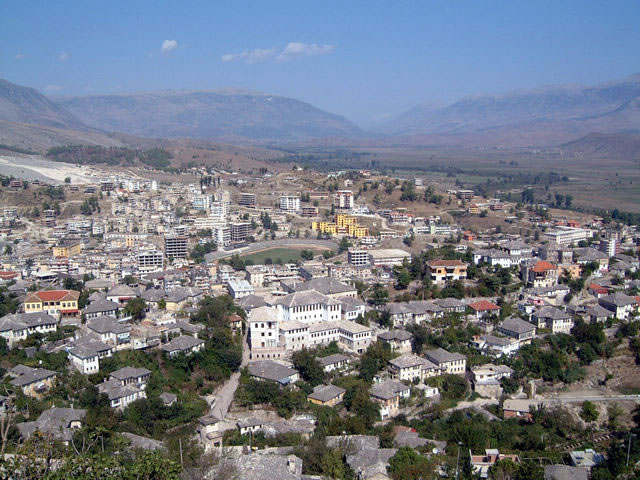 |
| View from the castle |
 |
| Hoxha's house |
 |
| Stone street with stone buildings |
So, there's a little village near Gjirokastër named Lazarat. It produces a lot of marijuana worth $6,000,000,000 (six billion) a year. Here's a YouTube video:
Ksamil Islands: four small islands
Miscellaeneous facts
- There's not a single McDonald's in Albania
- King Zog of Albania returned fire during an assassination attempt
- Smoking is widespread and technically prohibited indoors
- A nod means no; shaking your head means yes
- Blog written by an American Peace Corps Volunteer living in Shkoder
Pictures from Wikimedia


